Trusted bankruptcy lawyers serving clients across St. Louis for over 80 years.
If you are struggling with debt in St. Louis and the collection calls have turned into lawsuits, garnishment orders, or a notice of foreclosure, bankruptcy may be the legal tool that gives you a structured way forward. The decision to file for bankruptcy involves careful consideration of the financial circumstances and the legal options available. It involves federal court, detailed financial disclosures, and rules that change depending on whether the case is filed under Chapter 7, Chapter 13, or Chapter 11. Pioletti Pioletti & Nichols has handled bankruptcy matters for individuals and businesses for over 80 years. Our St. Louis, MO bankruptcy lawyer can assess your financial situation and explain which path makes sense.
Bankruptcy Lawyer St. Louis, MO
Bankruptcy exists so that people and businesses drowning in debt have a legal mechanism to either eliminate what they owe or reorganize it into something manageable. The process runs through federal court, not state court. In St. Louis, that means the U.S. Bankruptcy Court for the Eastern District of Missouri. Which chapter applies, what debts can be addressed, and what happens to the debtor’s property all depend on the specifics of the financial situation.
Most individuals in St. Louis who file bankruptcy choose between two options. Chapter 7 wipes out qualifying unsecured debts through a liquidation process that wraps up in a few months. Chapter 13 sets up a court-supervised repayment plan that runs three to five years. The eligibility rules are different for each, and the consequences are different too. A St. Louis bankruptcy attorney can look at the income, the debts, and the assets and provide a clear recommendation on which chapter fits.
Types of Bankruptcy and Debt Relief Cases We Handle in St. Louis
Debt problems do not arrive in a single form. The homeowner who fell behind on mortgage payments after a medical crisis is in a different position than the wage earner watching a quarter of every paycheck disappear to a garnishment. Pioletti Pioletti & Nichols handles the following bankruptcy and debt relief matters in St. Louis.
- Chapter 7 bankruptcy. This is the liquidation chapter. Most unsecured debts are eliminated, and the case typically closes within three to four months. Filers must pass the means test, and Missouri’s exemption laws determine which property is protected from liquidation.
- Chapter 13 bankruptcy. Chapter 13 is built for people with regular income who want to keep their property while repaying debts over three to five years. One monthly payment goes to the trustee, who distributes it to creditors according to the plan. This chapter is often the right choice for homeowners behind on the mortgage or for filers whose income exceeds the Chapter 7 threshold.
- Chapter 11 bankruptcy. Primarily a business reorganization tool, though individuals whose debts exceed the Chapter 13 limits can file here as well. The debtor continues operating while restructuring financial obligations under court oversight.
- Car repossession. The automatic stay can halt a repossession before it happens. Under Chapter 13, the vehicle loan folds into the repayment plan, and in some circumstances the secured portion of the debt can be reduced to the car’s actual value.
- Debt consolidation. Chapter 13 functions as court-supervised consolidation. One payment per month to the trustee replaces the multiple creditor payments, different due dates, and collection pressure that come with managing unaffordable debt on your own.
- Foreclosure. Filing triggers the automatic stay, which stops a foreclosure immediately. Chapter 13 then allows the homeowner to catch up on missed payments through the plan while staying in the home.
- Wage garnishment. Bankruptcy stops garnishments the moment the petition is filed. The debt that triggered the garnishment is addressed through the case itself rather than through involuntary paycheck deductions.
- Means test analysis. The means test controls access to Chapter 7. It compares household income to the Missouri state median and factors in allowable deductions. We prepare clients for bankruptcy by running these numbers before the petition goes to court.
Why Choose Pioletti Pioletti & Nichols as My Bankruptcy Lawyer in St. Louis, MO?
Bankruptcy Representation in the St. Louis Area
Joe C. Pioletti is a member of the Illinois State Bar Association and handles individual and commercial bankruptcy, personal injury, wrongful death, workers’ compensation, and criminal defense at Pioletti Pioletti & Nichols. Joe graduated from Eureka College in 2010, earned his J.D. from SIU School of Law three years later, and holds admission to the U.S. District Court for the Central, Northern, and Southern Districts of Illinois and the Northern and Southern Districts of Indiana.
The firm has represented bankruptcy clients in St. Louis for over 80 years. Because bankruptcy is federal law, the substantive rules are the same everywhere. What changes from one district to the next is how the court operates, what the assigned trustee expects to see in a petition, and how aggressively local creditors contest filings. Our familiarity with the Eastern District of Missouri shapes how we draft petitions, build repayment plans, and prepare for objections that might otherwise catch a debtor off guard.
St. Louis Bankruptcy Infographic
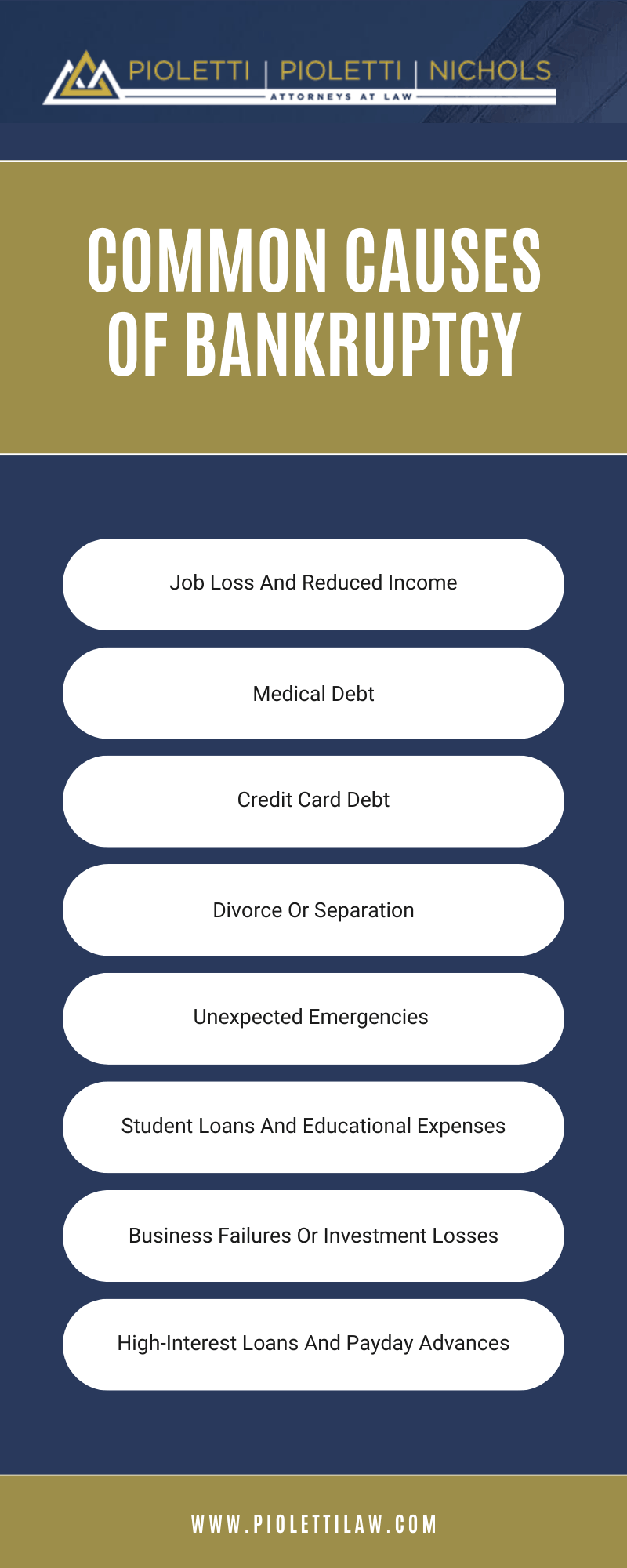
Understanding Bankruptcy Cases
Chapter 7 vs. Chapter 13 and What Qualifies
Choosing between Chapter 7 and Chapter 13 depends on income, assets, and what the debtor is trying to accomplish.
Chapter 7 is liquidation. Most unsecured debts are eliminated, and the case moves quickly. But non-exempt property can be sold to pay creditors, and a debtor whose household income exceeds the Missouri median will not pass the means test. Chapter 7 works well when the debtor has limited assets and an income level that falls within the eligibility range.
Chapter 13 is reorganization. The debtor proposes a repayment plan covering three to five years, and according to the U.S. Courts bankruptcy website, filers whose income falls below the state median generally qualify for a three-year plan while those above it typically propose five. The advantage of Chapter 13 is that the debtor keeps everything, including a house the bank is trying to foreclose on or a vehicle that is about to be repossessed.
Certain debts cannot be discharged under either chapter. Student loans, most tax debts, child support, and obligations arising from fraud survive bankruptcy regardless of which chapter is filed. We assess which debts a filing will actually resolve before recommending a course of action.
The FTC debt guidance program outlines bankruptcy and non-bankruptcy alternatives for consumers dealing with unmanageable debt.
Important Aspects of Bankruptcy Cases
Three elements drive the outcome of a bankruptcy case in St. Louis, and each one requires attention from the beginning.
The automatic stay activates the instant the petition reaches the court. Foreclosures, repossessions, garnishments, collection calls, and creditor lawsuits all stop. For a debtor in St. Louis who is dealing with collection pressure from multiple directions at once, the stay is the most tangible form of relief bankruptcy provides, and it takes effect before the court has reviewed anything beyond the petition itself.
Protecting assets in bankruptcy is the second major concern. Missouri’s exemption laws determine which property a debtor can keep when filing under Chapter 7. A home, a car, retirement savings, and personal property are all subject to exemption analysis, and understanding how the state’s exemptions apply to a particular debtor’s situation is critical to avoiding unnecessary loss of property.
The trustee is the third element. The U.S. Trustee Program oversees bankruptcy administration in the Eastern District of Missouri. The trustee reviews the petition, examines financial disclosures, and in Chapter 7 cases identifies any non-exempt assets available for creditor distribution. How well the petition is prepared directly affects how that review goes.
Bankruptcy Case Timelines
The length of a bankruptcy case in St. Louis depends on the chapter. Chapter 7 cases typically conclude in four to six months. Chapter 13 cases run three to five years. The procedural steps, however, follow a consistent sequence.
- Credit counseling. Federal law requires completion of a credit counseling course before the petition can be filed. There are no exceptions.
- Filing the petition. The petition, schedules, and supporting documents go to the U.S. Bankruptcy Court for the Eastern District of Missouri. The automatic stay takes effect at that point.
- 341 meeting of creditors. Roughly 30 to 45 days after filing, the debtor appears for a meeting where the trustee asks questions about the financial disclosures. Creditors may attend but rarely do in straightforward cases.
- Discharge or plan completion. Chapter 7 discharges typically arrive within 60 to 90 days after the 341 meeting. In Chapter 13, the debtor makes monthly payments for the duration of the plan, and the discharge follows the final payment and a required financial management course.
Rebuilding credit after bankruptcy takes time and discipline, but many people who have been through the process qualify for new credit within one to two years of the discharge.
What to Bring to Your Bankruptcy Consultation
The first meeting is about numbers. We need a full picture of income, debts, and assets before we can recommend a chapter or begin drafting the petition.
- Pay stubs or other proof of income going back at least six months
- The two most recent federal tax returns
- A complete list of debts with creditor names, account numbers, and balances, noting which are secured and which are unsecured
- Records for all assets, including property, vehicles, bank accounts, retirement funds, and anything else of significant value
- Any correspondence from creditors, collection agencies, or courts about pending lawsuits, garnishments, or foreclosure proceedings
We go through everything during the consultation, assess which chapter applies, and explain what the bankruptcy process involves from that point forward.
Missouri Legal Resources for Bankruptcy Cases?
Bankruptcy operates under federal law, but cases filed in St. Louis follow the local rules of the Eastern District of Missouri. The resources below provide background.
- The U.S. Courts bankruptcy website covers the bankruptcy process, including eligibility and procedural rules for each chapter.
- The U.S. Courts Chapter 13 page explains how repayment plans work from petition to discharge.
All St. Louis bankruptcy filings are administered through the U.S. Bankruptcy Court for the Eastern District of Missouri.
Reach Out to Pioletti Pioletti & Nichols to Schedule a Consultation
If you are considering bankruptcy in St. Louis, MO, Pioletti Pioletti & Nichols can review your financial situation and explain the available options. We have handled bankruptcy cases for over 80 years. Contact us to schedule a consultation with our St. Louis bankruptcy attorneys.
Bankruptcy Statistics in St. Louis, MO
 Bankruptcy filings in the St. Louis area run through the U.S. Bankruptcy Court for the Eastern District of Missouri, which processes cases from St. Louis City, St. Louis County, and surrounding counties. Consumer filings, meaning individual and joint personal bankruptcies, make up the overwhelming share of the caseload each year. Business filings account for a much smaller portion.
Quarterly filing data by district and chapter is published in the U.S. Courts data tables. Chapter 7 filings typically outnumber Chapter 13 filings in Missouri, though the ratio shifts with economic conditions. Job losses, medical debt, and rising interest rates all move the numbers. The BLS St. Louis data publishes metro unemployment and wage figures that correlate with consumer filing volume in the region.
Mistakes That Can Damage Your Bankruptcy Case
Bankruptcy is one of the more forgiving areas of federal law. But errors made in the run-up to filing are much harder to fix once the petition is on the docket. The mistakes below come up often enough in our St. Louis bankruptcy practice to warrant a warning. A St. Louis bankruptcy attorney can spot most of these before they harm your case.
- Running up debt before filing. Some people, once they’ve made the decision to file, treat the credit cards as an open spending line for the last few months. The Bankruptcy Code closes off that approach. Cash advances taken within 70 days of filing and luxury purchases within 90 days are presumed non-dischargeable. The debt survives the case.
- Transferring assets to family members. Signing over a car to a sibling or moving money into a relative’s account before filing looks like fraud to the trustee, because that’s often what it is. Trustees have the power to unwind those transfers, and the debtor loses both the asset and credibility with the court.
- Paying back preferred creditors. Repaying a family loan or a favored creditor in the months before filing counts as a preference under bankruptcy law. The trustee can claw the money back from that creditor and redistribute it to the general creditor pool, which usually leaves the debtor’s family member or friend worse off, not better.
- Omitting property from the schedules. The petition asks for a complete list of assets. Everything. Forgotten bank accounts, an old timeshare, a personal injury claim that hasn’t settled yet, a small investment account you’d stopped thinking about. Leaving assets off the schedules, even by accident, can lead to dismissal or fraud charges. Omitting property is one of the fastest ways to derail a case.
- Filing without understanding the exemptions. Missouri’s state exemption rules determine what property a Chapter 7 debtor gets to keep. Filing without knowing what fits inside those exemptions is how people lose homes they could’ve protected, or vehicles they could’ve kept. This analysis has to happen before the petition, not after.
- Signing a reaffirmation agreement without thinking it through. Reaffirming a car loan or a second mortgage keeps that debt out of the discharge. That decision has permanent consequences, and it shouldn’t be made under pressure from a lender. Mortgage reaffirmation in Chapter 7 deserves careful review before any signature.
- Believing the bankruptcy myths. Some clients arrive convinced that bankruptcy will destroy their credit forever, cost them their retirement, or make them unemployable for years. Most of what people think they know about bankruptcy is wrong. Common bankruptcy myths can prevent people from filing when it would help them, or push them into filing when a different option would work better. A single conversation with a bankruptcy lawyer clears up most of it.
St. Louis Bankruptcy Lawyer FAQs
How much does filing bankruptcy cost in St. Louis?
Attorney fees vary based on chapter, case complexity, and the number of creditors. Court filing fees are set by federal statute and are the same nationwide. Our firm offers flexible payment arrangements to offset the cost of filing Chapter 7 bankruptcy and make representation accessible during a period when cash is exactly what a debtor does not have.
Will my employer find out I filed bankruptcy?
In most cases, no. Bankruptcy filings are public record, but employers will not find out unless they are a creditor or unless a Chapter 13 wage deduction order is entered. Even then, federal law prohibits employment discrimination based on a bankruptcy filing.
Can I file bankruptcy while being sued?
Yes. The automatic stay stops civil lawsuits the moment the petition is filed, including debt collection cases, foreclosure actions, and garnishment proceedings. Timing matters when filing while being sued, particularly if a default judgment is close to being entered against the debtor.
Can my spouse file bankruptcy without me?
Yes. Missouri permits individual filings, and one spouse can file without the other. But the non-filing spouse’s income still counts in the means test, which can affect eligibility. Joint bankruptcy with a spouse sometimes makes more financial sense depending on how debts and assets are divided between the two.
How often can I file bankruptcy?
The rules depend on the chapter of the earlier case and the chapter of the new one. Eight years must pass between two Chapter 7 discharges. Four years between a Chapter 7 discharge and a Chapter 13 discharge. Two years between two Chapter 13 discharges. Filing within a wait period is still possible but produces no discharge. Even so, a second bankruptcy filing can stop a foreclosure or garnishment temporarily under the automatic stay.
Do I have to appear in court?
Every debtor must attend the 341 meeting of creditors, which isn’t technically a court hearing but a proceeding conducted by the trustee. Most consumer cases involve no other court appearance. Contested motions, discharge objections, and disputed reaffirmation agreements are the main situations where appearing in bankruptcy court becomes necessary.
Will bankruptcy affect my credit score long-term?
A Chapter 7 stays on the credit report for ten years, and a Chapter 13 stays for seven. But the impact on the score itself fades much sooner. Many filers see improvement within a year of the discharge. How bankruptcy affects a credit score over time depends more on new payment history than on the initial filing.
Can bankruptcy stop debt collection calls?
Immediately. The automatic stay applies to collection calls from the moment the petition is filed, and continued contact from a creditor after that point violates federal law. If you are already receiving collection calls, documenting them before filing helps if enforcement action becomes necessary.
What is life like after bankruptcy?
Better than most people expect. The debt is gone, the calls have stopped, and the wage garnishments are over. Rebuilding credit takes discipline, but many filers qualify for new credit within one to two years. For most clients, life after bankruptcy means secured credit within months, unsecured credit within a year, and mortgage eligibility within two to three.
Local Information for St. Louis Bankruptcy Cases
Eastern District of Missouri Bankruptcy Court and Local Resources
All bankruptcy petitions from St. Louis City and St. Louis County are filed with the U.S. Bankruptcy Court for the Eastern District of Missouri. The court sits at the Thomas F. Eagleton Courthouse. The 341 meetings and hearings on contested issues take place there or by video.
What Are Important Local Resources for St. Louis Bankruptcy?
- U.S. Bankruptcy Court. 111 South 10th Street, 4th Floor, St. Louis, MO 63102. (314) 244-4500.
- U.S. Trustee Region 13. 111 South 10th Street, Suite 6.353, St. Louis, MO 63102. (314) 539-2976.
- Credit Counseling Foundation. 844-865-2461.
- Money Management International. 866-889-9347.
Pioletti Pioletti & Nichols does not endorse or affiliate with any of the resources above. They are listed for informational purposes only.
About Pioletti Pioletti & Nichols
Pioletti Pioletti & Nichols was founded in 1938 by Don B. Pioletti Sr. and has served clients across Illinois and Missouri for over eight decades. Joe C. Pioletti handles the firm’s bankruptcy practice and is admitted before federal courts across Illinois and Indiana. The firm has helped many families work through bankruptcy filings over that span.
What Our Clients Say
★★★★★
Heather Nunn
“Do you lay up at night worrying about your debt?!? I DID until I called Joe here! He assisted me in understanding debt understanding bankruptcy and my concerns literally immediately ! I reached out and was able to speak to Joe that same moment ! He gathered everything I needed and assisted with my case immediately ! I have never been more pleased with an attorney as I am with Pioletti Pioletti & Nichols Law and the process they have made so smooth for me ! Thank you Joe!”
Read more reviews on our Google Business Profile.
Contact Pioletti Pioletti & Nichols
If you are considering bankruptcy in St. Louis, our attorneys can review your financial situation and explain what Chapter 7, Chapter 13, or another option would actually mean for your case. We offer flexible payment arrangements to make representation accessible during a period when it is most needed. Our office answers calls around the clock, so an initial conversation does not have to wait for business hours. Contact us to schedule a consultation with our St. Louis bankruptcy lawyers.
Client Reviews

We are Members of