Trial-tested truck accident lawyers committed to thorough preparation in every matter.
If you were involved in a collision with a commercial truck in St. Louis, the legal and medical issues that follow are often significantly more complex than those in a standard car accident case. The trucking industry operates under federal safety regulations and the insurer defending the case is usually a large commercial carrier with its own legal team. Pioletti Pioletti & Nichols has handled personal injury and truck accident cases for over 80 years. Our St. Louis, MO truck accident lawyer offers free consultations and takes these cases on a contingency fee basis.
Truck Accident Lawyer St. Louis, MO
Commercial trucks operate under a different set of rules than passenger vehicles. The FMCSA sets federal requirements for how long a driver can be on the road before resting, how often the vehicle must be inspected, and what qualifications the driver must hold. When a trucking company or driver violates those rules and someone in St. Louis gets hurt, a truck accident claim allows the injured person to pursue compensation.
The legal process involves identifying which federal regulations were broken, who was responsible, and how the violation led to the crash. Medical expenses, lost income, pain and suffering, and other losses are all recoverable. A truck accident attorney in St. Louis, MO who understands both state liability rules and the federal regulatory framework can identify every party that contributed to the collision.
Types of Truck Accident Cases We Handle in St. Louis
Truck crashes happen in different ways, and the type of collision determines what evidence matters and where liability falls. A jackknife on an interstate presents a different set of facts than a rear-end collision at a stoplight. Pioletti Pioletti & Nichols handles the following types of truck accident cases in St. Louis.
- Rear-end truck collisions. A loaded semi at highway speed needs far more stopping distance than a car. When the driver follows too closely, is distracted, or misjudges the gap, the result is a rear-end collision that crushes the vehicle in front. The force of impact at those weights causes brain injuries, spinal cord damage, and fatalities.
- Jackknife accidents. The trailer swings out at an angle to the cab, sweeping across multiple lanes. These crashes often involve driver fatigue, excessive speed for road conditions, or improperly maintained braking systems. The resulting collisions frequently involve several vehicles and multiple injured parties.
- Underride accidents. A smaller vehicle slides underneath the rear or side of a truck trailer, shearing off the roof. Occupants rarely survive without catastrophic injuries, and many of these collisions are fatal. Federal regulations require rear underride guards, but side underride protection remains inconsistent across the industry.
- Overloaded truck crashes. Exceeding weight limits changes the truck’s handling, extends stopping distances, and increases tire stress. When an overloaded truck causes a wreck, the shipper, the loading company, and the carrier may all share liability depending on who knew the load was over the legal limit.
- Wide turn accidents. Truck drivers making right turns swing the cab left to clear the corner with the trailer. Vehicles in adjacent lanes get caught between the trailer and the curb. These crashes happen frequently in urban St. Louis where truck traffic mixes with passenger vehicles at tight intersections.
- Tire blowout crashes. A tire failure on an 80,000-pound vehicle can send the truck across lanes or cause the driver to lose steering control entirely. Maintenance records, tire inspection logs, and liability issues involving the carrier’s maintenance program become central to the investigation.
- Drowsy driving collisions. Federal hours-of-service rules exist because fatigued truck drivers cause crashes. When a driver exceeds the allowable driving hours or falsifies log entries, the trucking company’s compliance practices become part of the claim.
- DUI truck accidents. A commercial driver operating a truck while impaired faces both criminal charges and a civil claim from the injured party. The civil case can include a claim for punitive damages, and evidence from the criminal prosecution often strengthens the injured person’s position.
Why Choose Pioletti Pioletti & Nichols as My Truck Accident Lawyer in St. Louis, MO?
Truck Accident Representation in St. Louis
Joe C. Pioletti graduated from Eureka College in 2010 and earned his J.D. from SIU School of Law in 2013. He is a member of the Illinois State Bar Association and handles personal injury, wrongful death, workers’ compensation, bankruptcy, and criminal defense at Pioletti Pioletti & Nichols. Joe is admitted to the U.S. District Court for the Central, Northern, and Southern Districts of Illinois and the Northern and Southern Districts of Indiana.
The firm has operated as a personal injury lawyer in St. Louis, MO since 1938 and has recovered millions of dollars for injured clients across the region. Truck accident cases are handled on a contingency fee basis, which means the injured person pays no attorney fees unless we recover compensation. Free consultations are available for truck accident cases in St. Louis.
St. Louis Truck Accident Infographic
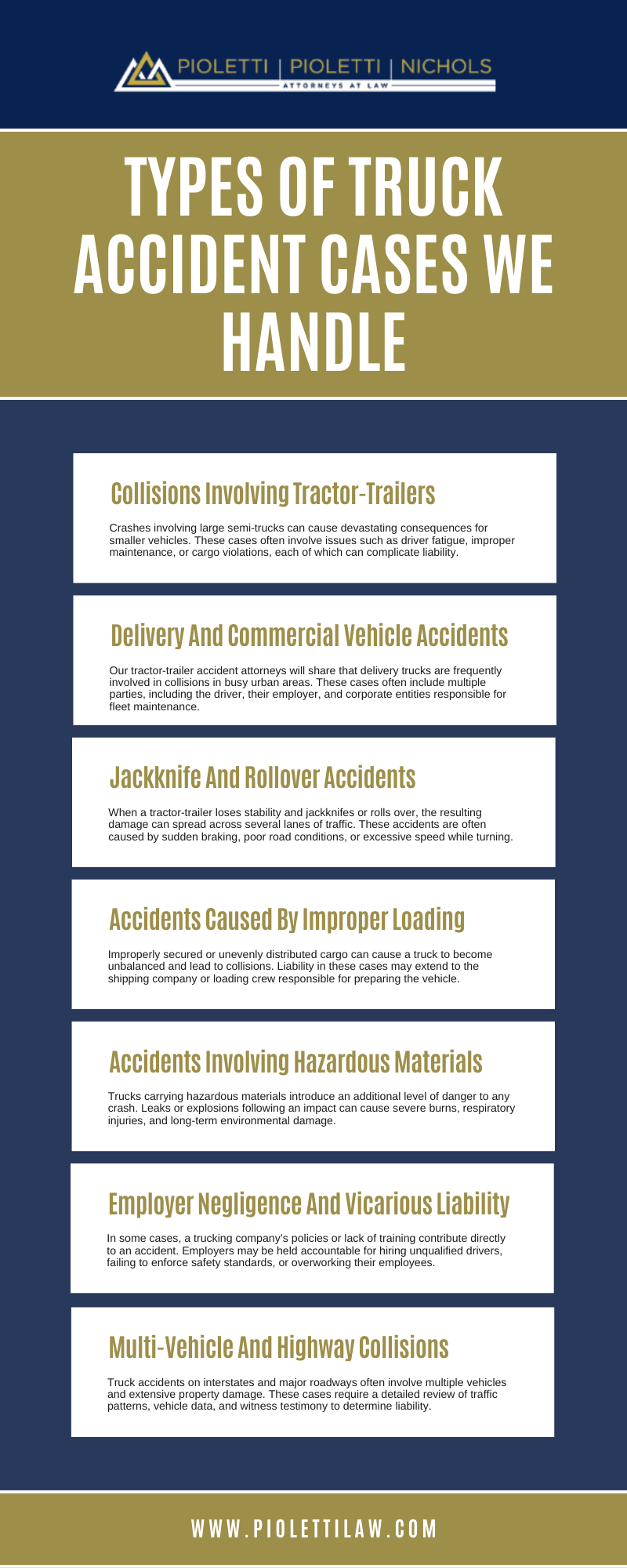
Understanding Truck Accident Cases
Damages, Liability, and Compensation for Truck Accident Cases
The size disparity between a commercial truck and a passenger vehicle is why truck accident injuries are so much worse than injuries from car-on-car collisions. An 80,000-pound rig hitting a sedan at highway speed generates forces that shatter bones, rupture organs, and cause traumatic brain injuries.
Medical bills in these cases regularly reach six figures. Emergency surgery, ICU stays, spinal procedures, months of rehabilitation. When the injuries are permanent, the claim projects future medical costs across the remainder of the person’s life. Lost wages cover income missed during recovery, and when the injuries prevent a return to the same occupation, the calculation extends to cover the lifetime reduction in earning capacity.
Missouri places no cap on non-economic damages in personal injury cases. A jury has full discretion to assign a dollar figure to pain, emotional distress, and the loss of enjoyment of life. Punitive damages can be added when the trucking company or driver acted with reckless disregard for safety. Under the pure comparative fault rule in RSMo § 537.765, the injured person’s recovery is reduced by their share of fault but is never barred entirely.
Important Aspects of Truck Accident Cases
What separates a truck accident case from a car crash case is the evidence. Truck accident cases in St. Louis involve components that simply do not exist when two passenger vehicles collide, and that evidence has to be secured fast because some of it disappears within days.
The truck’s black box records speed, braking inputs, and engine data from the moments before the collision. If the carrier is not given formal notice to preserve it, that data gets written over. Electronic driver logs reveal whether the trucker was within legal driving hours. Maintenance records show whether the rig was in safe condition when it left the yard. The driver qualification file contains the driving history, medical certification, and training documentation.
The liability picture is often wider than the injured person expects. Proving negligence requires establishing that someone owed a duty of care, broke it, and caused the injuries. But “someone” may be the driver, the carrier, the brake shop, or the shipper that overloaded the trailer. Multiple defendants and multiple insurance policies are common.
Truck Accident Case Timelines
These cases take longer than standard auto accident claims. The investigation is more involved, the evidence is more technical, and the insurance carrier on the other side has more at stake financially.
- Immediate preservation. A spoliation letter goes to the trucking company within days of the crash, directing them to preserve black box data, driver logs, and inspection records. Without it, critical evidence may be destroyed.
- Investigation. Police reports, accident scene photographs, witness accounts, and the truck’s regulatory records are collected. Accident reconstruction consultants may be brought in to establish how and why the collision occurred.
- Medical treatment. The case cannot be valued until doctors determine whether the injuries are permanent or whether treatment will improve the outcome. Settling before that point means accepting compensation without knowing the full cost.
- Demand and negotiation. We present the claim to the trucking company’s insurer. Commercial policies carry high limits, but the legal teams defending them are aggressive about reducing payouts.
- Filing the lawsuit. Missouri allows five years from the accident date to file under RSMo § 516.120. If negotiation does not produce a fair result, the lawsuit goes in before that window closes.
- Resolution. Most truck accident cases in St. Louis settle before trial. When a fair offer is not available, the case is decided by a jury in the St. Louis City or County Circuit Court.
What to Bring to a Truck Accident Consultation
The initial meeting is about getting the facts organized so the attorney can assess the claim and determine which parties bear responsibility for the crash.
- The police accident report
- All medical records and bills related to injuries from the truck collision
- Photographs of the crash scene, vehicle damage, and any visible injuries
- Correspondence received from the trucking company’s insurance carrier
- Insurance information for every party involved in the accident
We review the documentation during the consultation, identify the liable parties, and explain what the legal process involves from that point. Free consultations are available for truck accident cases in St. Louis, MO.
Missouri Legal Resources for Truck Accident Cases
Missouri personal injury law governs the deadlines, liability rules, and damage calculations for truck accident claims in St. Louis. Federal trucking regulations administered by the FMCSA add regulatory requirements that affect both liability and the investigation.
- Missouri gives injured parties five years from the date of the accident to file under RSMo § 516.120.
- The pure comparative fault rule under RSMo § 537.765 reduces compensation by the injured person’s percentage of fault without eliminating the claim.
- Missouri does not cap non-economic damages.
- NHTSA road safety data and CDC injury data provide statistics on large truck crash fatalities relevant to understanding truck accident risks on Missouri highways.
Reach Out to Pioletti Pioletti & Nichols to Schedule a Consultation
If you were injured in a truck accident in St. Louis, MO, Pioletti Pioletti & Nichols can evaluate the claim and explain the legal options available under Missouri law. We handle truck accident cases on a contingency fee basis, meaning no attorney fees are charged unless we recover compensation. Contact us to schedule a consultation with a St. Louis truck accident attorney.
Client Reviews

We are Members of